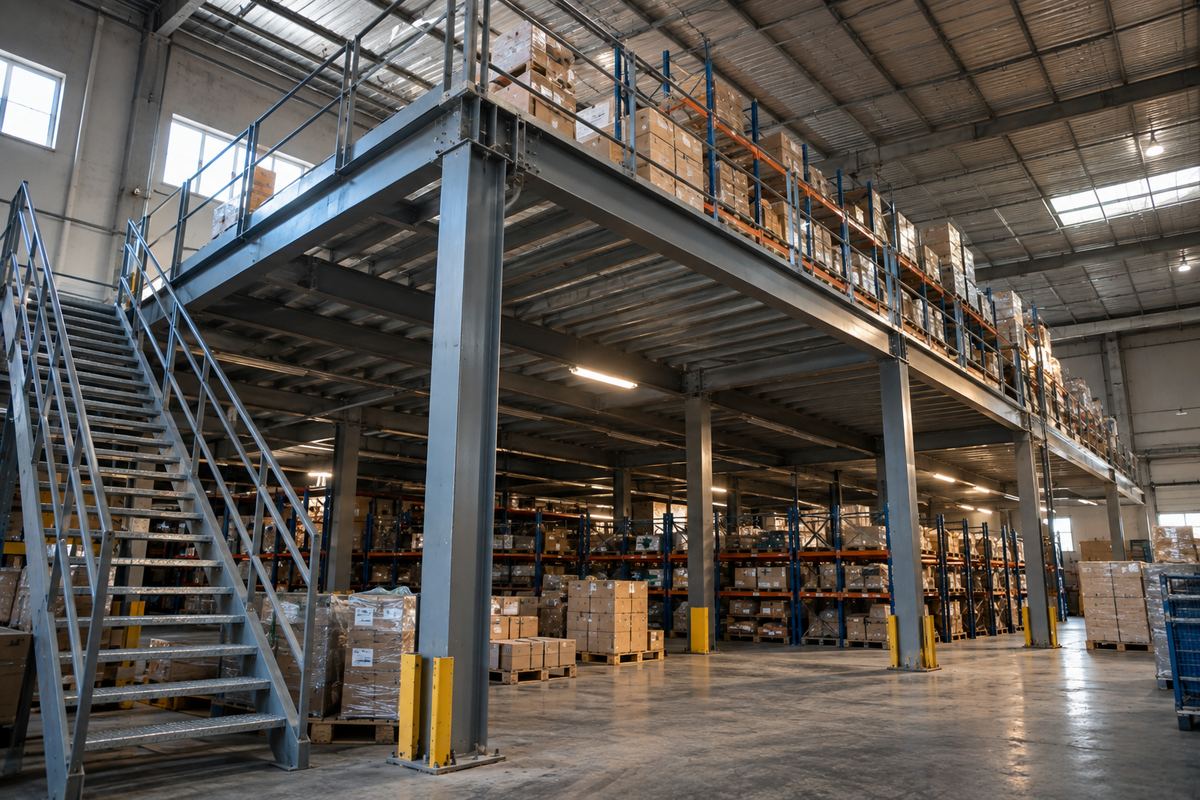
Pallet racking, shelving and mezzanine floors get lumped together as “the racks” in most conversations. They are answering three different questions: what carries a palletised unit load, what a person can pick by hand, and how you create an entirely new floor. Mixing them up is not just a vocabulary slip — it changes what the structure needs to be engineered to do.
Pallet racking: built for a forklift, not a hand
Racking carries palletised unit loads, handled by a forklift, reach truck or VNA truck. The level surface is usually just two open beams — the pallet itself bridges the gap and becomes part of the load path. Load per level runs from hundreds of kilograms to several tonnes, and the main design risk is buckling of the uprights or forklift impact damage.
Shelving: built for a hand, not a forklift
Shelving carries loose cartons, bins and small parts, loaded by hand. Because nothing bridges the gap the way a pallet does, the level itself has to be a solid panel or mesh able to support the load directly. Depth per bay is set by hand reach — typically 300–600 mm — not by a pallet footprint, and the failure mode to design against is toppling or overloading a thin shelf, not forklift impact.
Long-span shelving is where this gets confused in practice. It looks like pallet racking — uprights and beams — but it is engineered for hand loading of medium loads, not for a forklift dropping a pallet on it. If a forklift starts using long-span shelving as if it were racking, that is a structural failure waiting to happen, not a grey area.
Mezzanine: not storage, a structure
A mezzanine is not a storage system at all — it is a second floor. You then put racking, shelving or people on top of it. That distinction matters because a mezzanine's design risk is different in kind: floor loading expressed as kg/m² UDL, deflection, fire escape routes, and in many Indian municipalities and industrial estates, statutory approval from the local authority or fire department because it adds to covered area.
Some landlords contractually forbid mezzanines outright. Before we specify one, we ask directly whether it is approved by the landlord and, where applicable, by the local authority and fire department — and we want that answer in writing. Skipping that question is one of the fastest ways to lose an entire project's margin after the steel is already on site.
Why the distinction is worth getting right
Each of these three has a different regulatory posture — racking and shelving are usually treated as equipment, a mezzanine is often treated as construction. They have different failure modes, different load paths, and different things that can go wrong if specified by someone thinking in the wrong category. Getting the category right at survey stage is what the rest of the design depends on.
Not sure which category your problem is in?
Tell us what you are trying to store, how it is picked, and how much headroom you have. We will tell you whether you need racking, shelving, a mezzanine, or some combination.