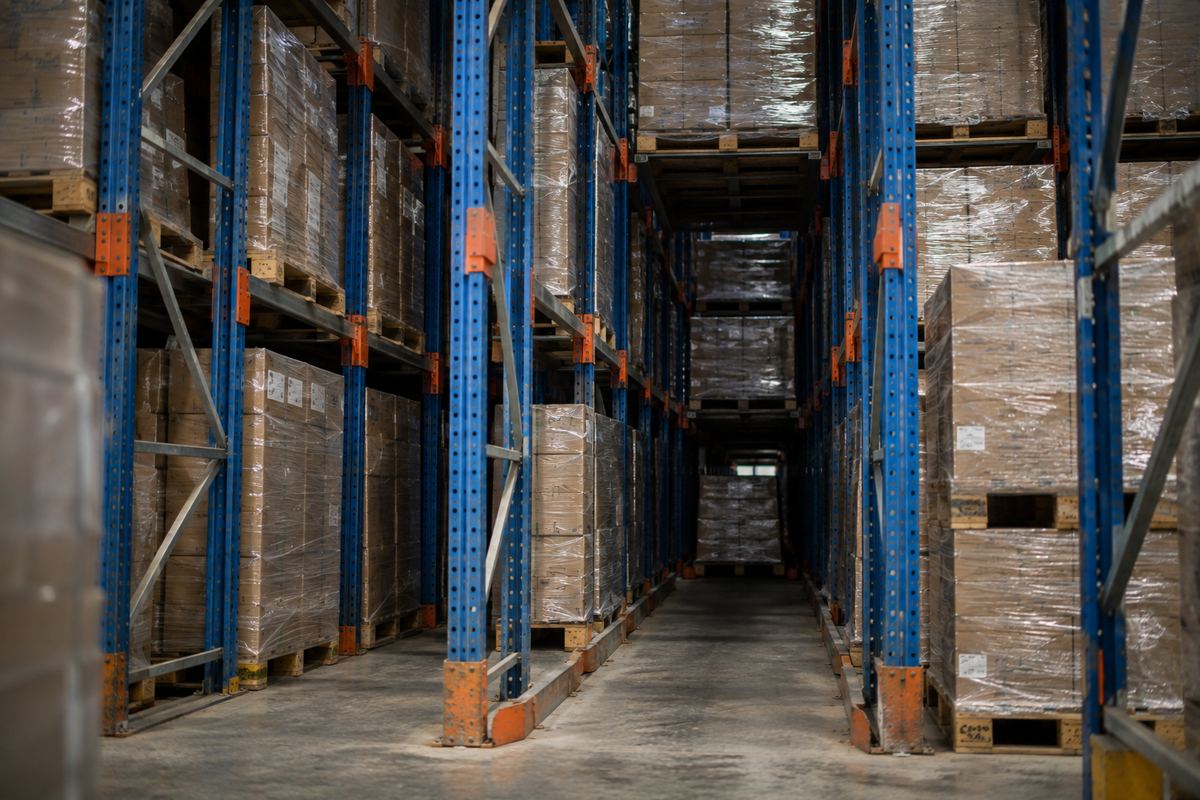
Most pallet racking sold in India is selective racking — the type with open bays and a beam pair at every level. It is the default because it makes no assumptions about your stock. Every other configuration is a deliberate trade: you give up some selectivity to buy back floor space, and the right trade depends entirely on your SKU count and pallets-per-SKU, not on which system looks most impressive.
Selective racking — the baseline
Every pallet is one forklift movement away. Any counterbalance or reach truck can work it, beams reposition on a 50/75 mm pitch as your stock changes, and it is the cheapest configuration per pallet position because it is the simplest to manufacture and install. The cost is floor space: roughly 40–50% of the area becomes aisle.
It is the right answer for high SKU counts, mixed and changing stock, and anywhere you genuinely do not know what you will be storing in two years. Under uncertainty, selective is the safe bet — and that is a real reason to choose it, not just a default.
Double-deep — more density, one new dependency
Two selective racks placed back-to-back with no aisle between them, so pallets store two deep from each aisle. You recover roughly a third of your aisles, at the cost of dropping selectivity to about 50% — only the front pallet of each pair is directly reachable, and access is LIFO within the pair.
The detail that catches people out: a standard reach truck cannot work double-deep racking. It needs a double-deep truck with a telescopic or pantograph fork. If the handling equipment is not confirmed before the racking is ordered, the layout does not work on commissioning day — so we put the truck model on the quotation as a stated assumption, not an afterthought.
Drive-in and drive-through — density before selectivity
Instead of beams across the front, drive-in racking has rails running front-to-back along the lane, and the forklift drives inside the structure to place or retrieve a pallet. Density is very high; selectivity is very low, often only the front pallet of each lane and level. Access is strictly LIFO.
This is where cold storage lives — when every cubic metre is expensive to refrigerate, density matters more than pick flexibility, and a single-grade raw material or a small number of high-volume SKUs suits the lane structure well. Drive-through is the same idea open at both ends, enforcing FIFO by geometry rather than by discipline, at the cost of needing aisle access on both sides.
Both are structurally less forgiving than selective — the front face (and, for drive-through, the rear face too) cannot be braced, so the whole structure leans on top ties, bracing and anchoring. This is not a configuration to specify cheaply.
Push-back — drive-in’s density without driving in
Nested carts on inclined rails hold two to six pallets per lane. Load the front cart and it pushes the pallets behind it back and up the slope; unload it and gravity brings the next one down to the face. The forklift never leaves the aisle, which is the whole advantage over drive-in — far less impact damage, faster cycles, and each lane can still hold a different SKU. The trade is cost: carts and rails are precision components, and it typically prices above selective per pallet position.
The question that actually decides it
Configuration choice is not a preference, it is arithmetic: how many SKUs, how many pallets per SKU, what handling equipment is already on site or budgeted, and whether FIFO is a genuine requirement or just a habit. Get those four numbers right and the system follows from them. Get them wrong and you are either paying for aisles you did not need, or you have bought a dense system that cannot reach the stock you actually pick often.
We ask for those numbers at survey stage, before we draw anything — because the layout that suits a comparable warehouse down the road is rarely the layout that suits yours.
Not sure which configuration fits?
Send us your SKU count, pallets per SKU and the handling equipment you have. We will tell you what fits before we draw anything.